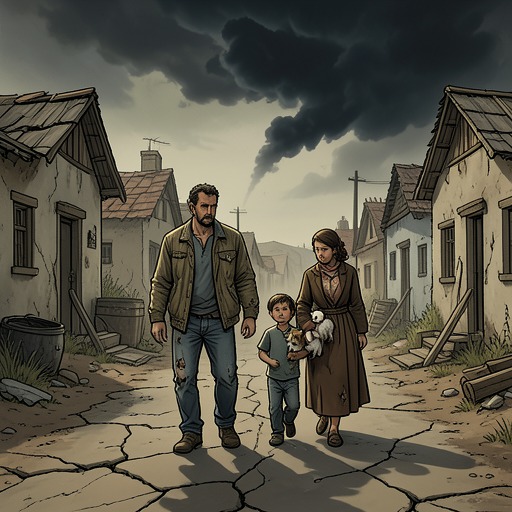
Narovlya
Voices from ChernobylNarovlya is presented as a small Belarusian town where two kinds of displacement meet: people fleeing violence elsewhere find a place to live, while residents close to the Chernobyl reactor discover that familiar land and daily routines have become dangerous. The testimonies make the town neither a simple refuge nor merely a point on a contamination map. It is a place where shelter, work, fear, and the limits of official information shape one another.
A town near the reactor
On April 27, the day after the explosion at the Chernobyl Nuclear Power Station, a scientist traveled through the Gomel Region to measure radiation in major towns. Narovlya was among the places he visited, only twenty to thirty kilometers from the station. His instruments registered 28,000 micro-roentgen per hour there. In Bragin, another town on the route, the reading was 30,000. The figures were difficult to communicate: residents had not received orders to stop their ordinary activities, and the language of roentgens sounded remote from the demands of the day.
People were still outside sowing and mowing, preparing for Easter, coloring eggs, and baking Easter cakes. The scientist’s measurements and the residents’ actions occupy the same scene, but they belong to different understandings of reality. He carried instruments and tried to explain an invisible danger; people continued work because the authorities had given them no instruction to do otherwise. The contrast makes Narovlya’s exposure concrete without suggesting that its residents could readily interpret what the readings meant.
A resident recalls that, when her mother ran to warn her that Chernobyl had exploded, she was sunbathing. She laughed at the alarm because Narovlya was forty kilometers from Chernobyl. That response captures the distance as it first appeared to someone living there: close enough to be named, yet seemingly far enough for danger to feel implausible. The recollection begins with an ordinary Sunday and records how quickly that sense of distance could fail.
The arrival of refugees
Another testimony gives Narovlya a different meaning. A nurse who had experienced violence in Tajikistan came to Belarus while pregnant and settled in the town. The experience she recounts explains why safety there did not erase what had happened before. During a difficult birth at the maternity ward where she worked, armed men entered demanding drugs and alcohol. When the staff did not provide them, the men threw the newborn out of a window. The nurse describes the shock as something she could not put aside; afterward, the skin came off her hands, her veins swelled, and she struggled to get herself to work. Pregnant herself, she felt unable to give birth in the place where she had witnessed the killing and left for Belarus.
In Narovlya she found a small, quiet town, a house provided for her family, and a job for her husband. She says that she felt less afraid there, even while describing her family as left without a homeland. Russia did not feel like home to her; the homeland she had been raised to imagine was the Soviet Union. The town’s provision of a house and work offered practical security, but it could not settle the deeper question of belonging raised by the end of that shared political world.
Her account also describes friends who came to Narovlya after receiving a letter from the family. They arrived at night and remained at the train station, sitting on their suitcases and keeping their children close, afraid to go out. The town’s ordinary street life astonished them. At a shop they found butter and cream, goods they said they had not been able to buy for two years; they bought five bottles of cream and drank them there. The contrast with conditions in Tajikistan, where bread could not be bought amid war, shows what Narovlya could offer these newcomers in immediate, tangible terms: food, a street they could walk on, and a house where they could stay.
Ordinary life interrupted
The resident’s memory of the first days after the explosion turns from her sunlit Sunday to the arrival of a friend and her husband, who had escaped from Pripyat. They reached the house by way of forest paths and small village roads while police patrols and military checkpoints were preventing people from leaving. The visitors had come in a bathrobe, an athletic suit, and old slippers. They had left new furniture, a refrigerator, and other belongings behind, wrapped in cellophane, unsure what would happen next.
The household then spent days watching television for an explanation. The account emphasizes the silence of the authorities before Mikhail Gorbachev appeared after the major holiday to say that the situation was under control. His reassurance arrived after the refugees had already fled and after Narovlya’s residents had begun confronting reports of danger. In the town’s recollection, the gap between official speech and lived uncertainty is part of the event itself: people had to respond before they received a dependable account of what was happening.
Shelter, exposure, and the surrounding zone
Narovlya’s two roles—as a destination for people escaping violence and as a town exposed to fallout—prevent either meaning from becoming complete. For the displaced nurse, it was safer than the place she had left; for residents and visitors in the days after the reactor explosion, it was close to an unseen threat that official silence did not make less real. The town’s calm streets and provision of housing stand beside measurements of extreme radiation and the interruption of ordinary life.
Elsewhere in the book’s accounts of the affected Belarusian countryside, soldiers describe guarding evacuated villages and stopping former residents from retrieving household objects or harvesting their crops. They recall a disorienting division between people kept out and agricultural work continuing nearby, with milk, eggs, and potatoes ultimately discarded or buried. These accounts do not establish that every described checkpoint or farm lay within Narovlya itself; they show the wider conditions surrounding towns such as Narovlya, where daily life and official measures against contamination could pull in opposite directions.
The town’s significance rests in this proximity of unlike experiences. It receives people seeking refuge, yet it is also one of the places where radiation was measured and where neighbors initially continued working without understanding the danger. Its testimony holds together what a single label would separate: a quiet settlement, a home offered to displaced families, and a community situated within the reach of the Chernobyl disaster.